
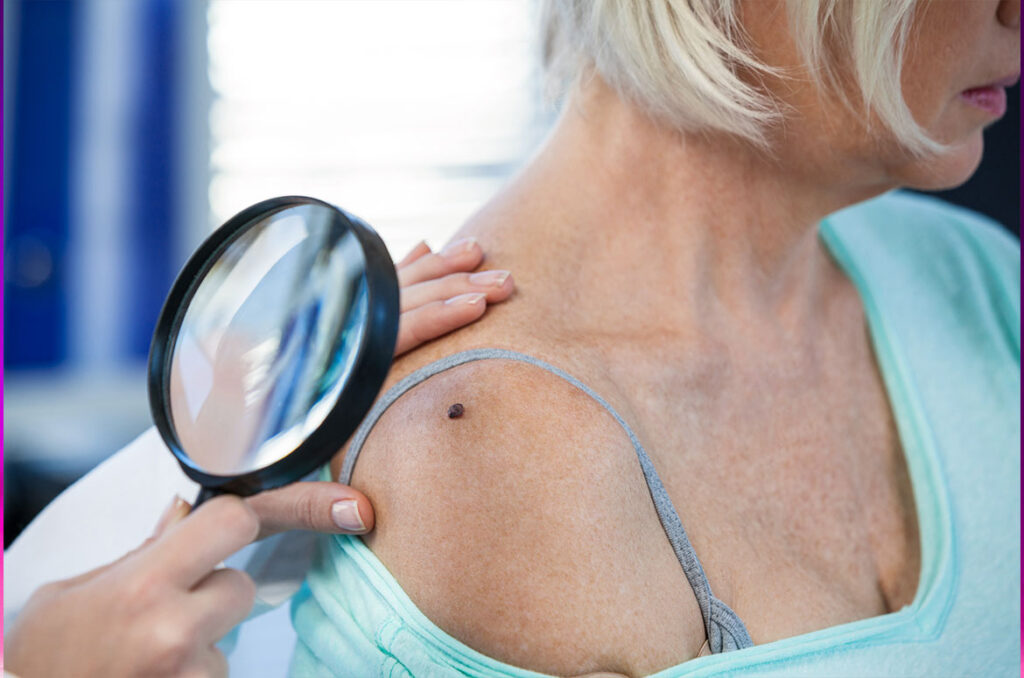
Skin cancer is one of the most common cancers worldwide, yet it’s also one of the most preventable and treatable when detected early. Knowing how to check your moles at home can play a crucial role in identifying potential warning signs before they become serious.
This guide explains how to examine your skin, what changes to look for, and when to seek professional advice.
Why Checking Your Moles Matters
Moles are common and usually harmless. However, some can develop into melanoma, the most serious type of skin cancer.
Early detection significantly improves outcomes. In many cases, melanoma can be treated successfully if caught in its early stages, often before it spreads.
Regular self-checks help you:
- Notice changes early
- Track new or evolving moles
- Identify unusual patterns on your skin with the online skin screening tool
The ABCDE Rule: The Most Important Skin Cancer Check
Dermatologists use the ABCDE rule to evaluate moles for potential warning signs.
A – Asymmetry
One-half of the mole does not match the other in shape or size.
B – Border
Edges are irregular, blurred, or jagged rather than smooth.
C – Colour
Multiple colours (brown, black, red, white, or blue) appear within the same mole.
D – Diameter
The diameter is larger than 6mm, approximately the size of a pencil eraser, although smaller melanomas can also occur.
E – Evolution
Any change in size, shape, colour, or symptoms (itching, bleeding, or pain).
Among these, evolution (change over time) is often the most critical sign.
Step-by-Step: How to Check Your Moles at Home
Performing a skin check only takes a few minutes and can be done monthly.
1. Use Good Lighting
Stand in front of a mirror in a well-lit room. Natural light works best.
2. Check Your Entire Body
Examine all areas, including:
- Face and neck
- Chest and back
- Arms and hands
- Legs and feet
- Scalp (use a comb or ask for help)
Don’t forget areas that are often overlooked, such as:
- Between toes
- Under nails
- Behind ears
3. Look for the “Ugly Duckling” Sign
This term refers to a mole that looks different from all your others.
Most people have moles that look similar. A mole that stands out in size, colour, or shape, should be examined more closely.
4. Monitor Symptoms (Not Just Appearance)
While visual changes are key, also pay attention to:
- Persistent itching
- Bleeding or crusting
- Pain or tenderness
- A mole that won’t heal
Interestingly, many early melanomas are painless, so the absence of pain does not mean a mole is safe.
5. Track Changes Over Time
Taking photos can help you compare moles over weeks or months.
Subtle changes are often difficult to notice from memory alone, but visual tracking makes patterns clearer.
When Should You Be Concerned?
You should seek medical advice if a mole is:
- Changes in size, shape, or colour
- Looks significantly different from others
- Bleeds or crusts without injury
- Continues to evolve over weeks
- Shows multiple ABCDE signs
Even if only one feature is present, it’s worth getting checked, especially if the change is new.
The Role of Technology in Skin Monitoring
Recently, digital tools have made it easier to monitor skin changes consistently.
For example, tools like AI skin analysis platforms can help identify patterns and highlight features aligned with clinical criteria such as the ABCDE rule. These tools are not a replacement for medical diagnosis, but they can support early awareness and help users decide when to seek professional evaluation.
Common Causes of Benign Mole Changes
Not all mole changes indicate cancer. Many are caused by:
- Friction from clothing
- Hormonal changes
- Sun exposure
- Minor injury or irritation
However, distinguishing between harmless and concerning changes can be difficult without proper evaluation, which is why monitoring is important.
How Often Should You Check Your Skin?
Most dermatologists recommend:
- Monthly self-checks for general awareness
- More frequent monitoring if you have:
- Many moles
- A history of skin cancer
- Fair skin or high sun exposure
When to See a Dermatologist
Self-checks are useful, but they do not replace professional evaluation. You should consult a dermatologist if:
- You notice any suspicious changes
- A mole continues evolving over time
- You feel uncertain about a spot
Dermatologists may use tools like dermoscopy or perform a biopsy if needed.
Final Thoughts
Checking your moles regularly is a simple habit that can have a significant impact on your long-term health.
By using the ABCDE rule, watching for unusual changes, and tracking your skin over time, you can improve early detection and make more informed decisions about your skin health.
If something doesn’t look right, it’s always better to get it checked; early action can make all the difference.